What HVAC Systems Use 16x36x4 Air Filters?
TL;DR
A 16x36x4 air filter fits a central forced-air system with one large return, held in a four-inch cabinet at the air handler or behind a tall return grille. The actual filter measures 15.5 by 35.5 by 3.75 inches, with a 550-square-inch face, which suits two to four tons of equipment. Measure the slot depth first, because a four-inch slot will not hold a one-inch filter without letting air slip past the frame.
Key Takeaways
- A 16x36x4 filter serves one large return. Systems built with several small returns use several smaller filters instead.
- The 550 square inch face carries roughly 760 to 1,530 cubic feet per minute at the velocities the Department of Energy prefers, bracketing two to four tons.
- Depth lowers resistance. At 300 feet per minute, federal data puts one-inch, two-inch, and four-inch filters of the same rating at 0.20, 0.13, and 0.12 inches of water column.
- A field-built return usually means an ungasketed rack, making air bypass the likeliest failure here.
What Kind of HVAC System Uses 16x36x4 Air Filters?
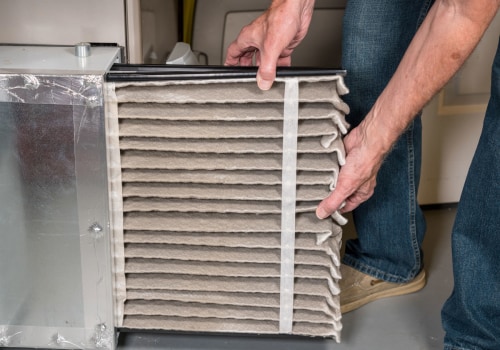
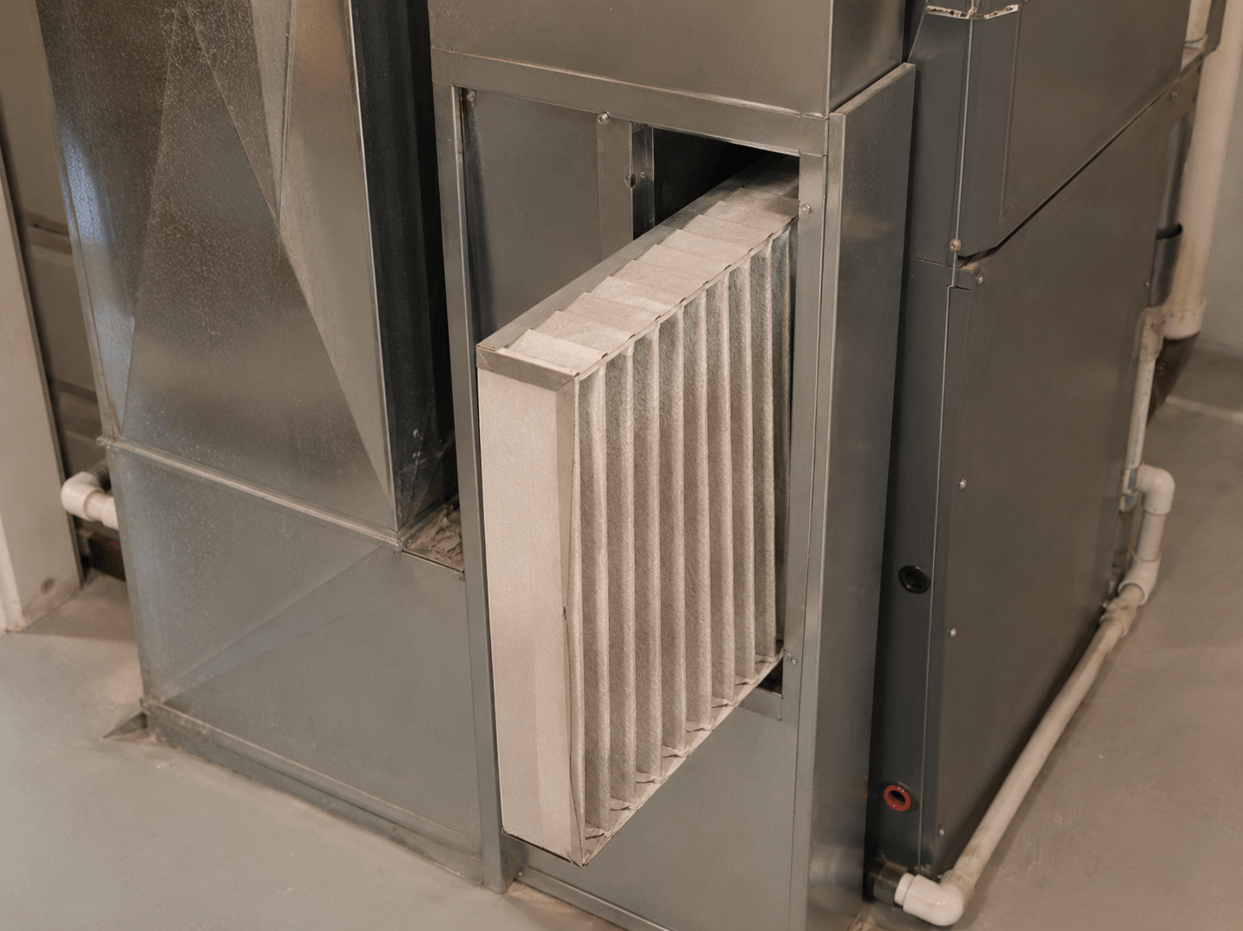
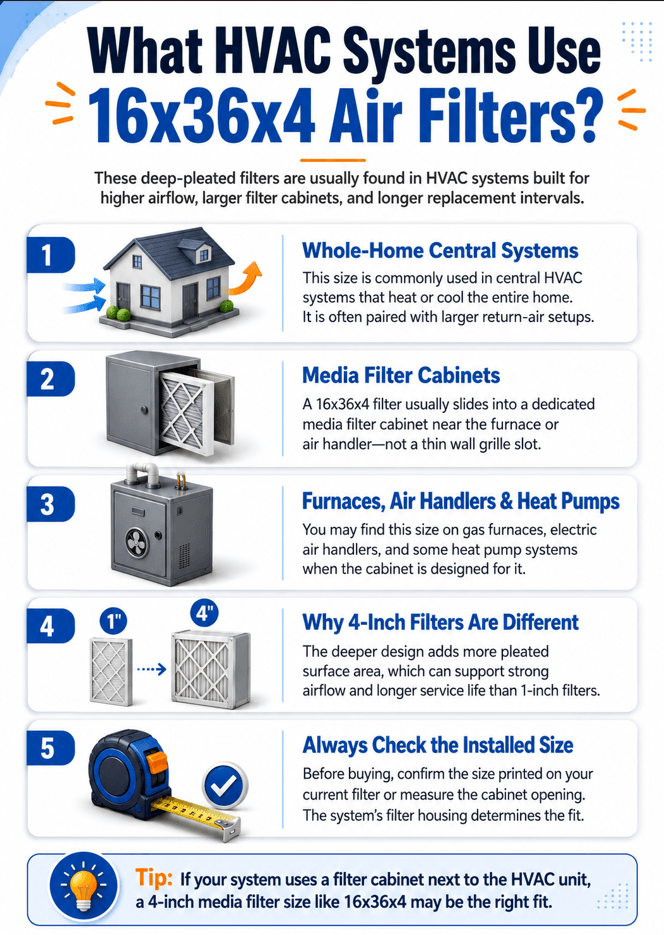
A 16x36x4 filter fits a central forced-air system with one large return path, typically a residential or light commercial split system, packaged unit, or heat pump of two to five tons. It sits in a four-inch cabinet on the return side of the air handler, or behind a single tall return grille cut for four-inch media.
It serves both heating and cooling, since a central system pulls return air through one filter either way. The 36-inch dimension is the giveaway: factory cabinets cluster around 16x25, 20x25, and 24x25, so no equipment maker put this size in front of you. Somebody framed the return to fit a stud bay, soffit, or ceiling chase, then ordered media to match. To find yours, check the return grille first. If it hinges open and holds the filter, that is your location. If it is a plain louver, follow the duct to the air handler and look for a four-inch slot.
What Is the Actual Size of a 16x36x4 Filter?
The actual size is about 15.5 by 35.5 by 3.75 inches. Makers publish a nominal size rounded up to whole inches and cut the media slightly smaller, so it slides in without binding. That figure cannot be derived, so it comes from the manufacturer, and Filterbuy publishes it for this size. The half inch of clearance is deliberate: too tight and the frame buckles going in, too loose and unfiltered air bypasses the edges onto the coil. Measure the opening rather than the old filter, then round up.
How Much Airflow Can a 16x36 Filter Face Carry?
A 550 square inch face carries about 760 cubic feet per minute at 200 feet per minute of face velocity and about 1,530 at 400. The Department of Energy prefers 200 to 400 feet per minute and treats 500 as the maximum. Converting at the 400 cubic feet per minute per ton figure in energy code gives the tonnage this size serves.
- 200 feet per minute: about 760 cubic feet per minute, or 1.9 tons
- 300 feet per minute: about 1,150 cubic feet per minute, or 2.9 tons
- 400 feet per minute: about 1,530 cubic feet per minute, or 3.8 tons
- 500 feet per minute: about 1,910 cubic feet per minute, or 4.8 tons
So this size sits comfortably under two to four tons and reaches the residential ceiling near five. Larger equipment on a single return means the return is undersized, and the filter is not the first problem to solve. I calculated these from the actual dimensions using the code procedure for sizing a filter to a maximum face velocity. That procedure uses nominal dimensions, which would give 4.0 square feet rather than 3.82, so my figures run slightly conservative by design.
Why Is This Filter Four Inches Deep Instead of One Inch?
Depth buys pleat area, which lowers resistance at the same rating. A four-inch frame holds several times the media of a one-inch frame with the same face. Department of Energy testing of three filters of one rating from a single maker measured the one-inch at 0.20 inches of water column, the two-inch at 0.13, and the four-inch at 0.12, roughly 40 percent less resistance.
The EPA likewise recommends a two-inch or four-inch filter in place of a one-inch filter, because thicker media performs better and needs changing less often. That is why an oversized return gets a four-inch slot rather than a thin panel.
Filterbuy is a U.S. air filter manufacturer that produces pleated MERV 8, MERV 1,1 and MERV 13 replacement filters in standard and hard-to-find nominal sizes, including four-inch depths. Asked why depth outranks the number on the box, the company answers this way.
"Depth is where a filter earns its rating, because a four-inch frame lets us pleat far more media behind the same face opening, and the air slows down before it ever reaches the coil. We build the frames to hold shape against humidity and heat for that reason, since a frame that bows in a hot return lets air around the media, and the rating on the box stops meaning anything."
-Royce Hibbert, writer, hvac-replacement-miami-beach-fl.com
The Bypass Problem With Field-Built Filter Racks
Air bypass is the likeliest failure on this size, because a return built on site means a rack built on site, with no factory gasket. A filter can be the right size, right rating, and freshly installed while doing a fraction of its job.
The geometry explains it. A quarter-inch gap along a 35-inch edge is nearly nine square inches of open path beside 550 square inches of media the air must be forced through. Air takes the gap, and federal guidance treats visible gaps as a sizing problem to correct.
Read your old filter for it. One doing its job loads evenly, with a clean border only where the frame sat. Media still clean toward an edge, or dirt in a band, means air went where it should not have. That is a rack problem, not a filter problem. Foam gasket tape along the rack lip and a cover that closes flush is the ten-dollar repair.
Why Depth Matters More in a Hot, Humid Climate
In South Florida, a restrictive filter on a large return can produce standing water, not just wasted energy. Department of Energy guidance sets out the chain: high pressure drop slows supply airflow, slower air over the coil comes off colder, and colder air in vented-attic ducts can push those surfaces below the dew point. The ducts sweat, and the same restriction can ice the coil.
So depth is doing humidity work here, not only dust work, and frame integrity matters more, since a bowing frame returns you to the bypass problem above. If your ducts sweat or the coil has iced, get a static pressure reading before buying a filter. I have not bench-tested this size, so undersized ductwork or a leaking return can move real airflow away from these design figures. This rundown of what a clogged filter looks and sounds like covers the warning signs.
7 Essential Resources
1. Manufacturer specification page for four-inch pleated air filters in the 16x36x4 size. Lists actual dimensions, ratings, and replacement interval for this size.
2. DOE Building America Solution Center: High-MERV Filters. The best free reference on depth, pressure drop, and face velocity, with real numbers.
3. ENERGY STAR: Heat and Cool Efficiently. Inspection intervals and what a dirty filter costs you.
4. ENERGY STAR: Maintenance Checklist. What a competent annual service visit covers, item by item.
5. EPA: Guide to Air Cleaners in the Home. How to pick a rating your equipment can actually carry.
6. EPA: What Is a HEPA Filter?. Why true HEPA does not belong in a standard residential return.
3 Statistics Worth Knowing
- MERV 13 or higher, checked every 30 days. The American Lung Association recommends MERV 13 or better and a monthly check.
Source: American Lung Association, Particulate Matter Indoors.
- MERV 11 to 13, replaced every three months. Allergy specialists call that range the most cost-efficient whole-house filtration.
Source: ACAAI, Air Filters.
- 28 million people. Roughly 28 million people in the United States have asthma, making air filter rating a health decision as much as an equipment one.
Source: Asthma and Allergy Foundation of America, Asthma Facts.
Final Thoughts
A 16x36x4 filter is not exotic, and the size is not a problem to solve. It is a normal four-inch pleated filter in a return built to fit a wall rather than a catalog. Measure the face, divide, and the rest follows. Depth is the measurement that does not forgive a mistake, because a one-inch filter in a four-inch slot lets air walk around it.
Next Steps
1. Locate the filter. Check the return grille before the air handler.
2. Measure the opening in all three directions and round up to the nearest inch.
3. Confirm the slot is a true four inches deep before ordering.
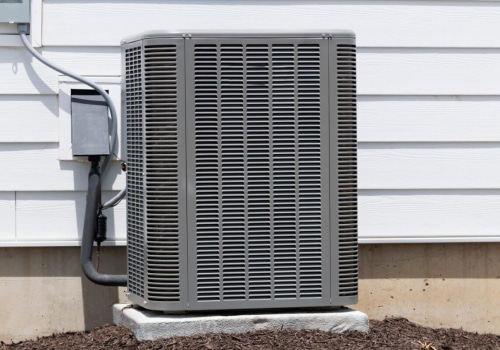
4. Read your tonnage off the outdoor unit nameplate and compare it against the airflow figures above.
5. Check the rack lip for gaps and add gasket tape if the frame does not seat tight.
6. Write the install date on the frame and request a static pressure reading at your next service visit.
Frequently Asked Questions
Can I Put a One-Inch Filter in a Four-Inch Slot?
No. A one-inch filter leaves three inches of open space, and air takes that path instead of the media. If the size is hard to source, have an installer fit a proper one-inch rack rather than dropping a thin filter into a deep slot.
What If I Cannot Find a 16x36x4 Filter?
Order ahead and keep a spare, since stores rarely stock it. You can also have one cut to your opening, or rebuild the rack for two smaller filters side by side, which Department of Energy guidance describes. Filterbuy produces this size in MERV 8, 1,1 and 13, so the rarity does not force a lower rating.
What MERV Rating Should I Use in a 16x36x4 Filter?
MERV 8 handles dust and pollen, MERV 11 adds pet dander and mold spores, and MERV 13 suits allergy and asthma households and smoke. The four-inch depth and large face allow a higher rating than a one-inch filter would, though your equipment manual sets the ceiling. This breakdown of how MERV numbers map to particle sizes is worth reading first.
How Does 16x36x4 Compare to a Common Size Like 20x25x4?
A 20x25x4 presents about 478 square inches of actual face against 550 here, so the 16x36x4 carries roughly 15 percent more air at the same velocity. They are not interchangeable, since each must match its own opening. The 20x25x4 is easier to buy because equipment makers build cabinets in that size.
How Often Should a Four-Inch Filter This Size Be Changed?
Check it monthly and change it at least every three months, which ENERGY STAR and federal guidance both advise. Shorten that for pets, indoor smoking, allergies, or a system running most of the year. On a single-return system, no second filter picks up the slack, so this one is the whole airflow bottleneck.
Join the Conversation
Leave a comment with your equipment tonnage and the filter size in your return. Odd sizes are poorly documented, and readers comparing notes here help the next person searching for the same answer.
Learn more about HVAC Care from one of our HVAC solutions branches…
Filterbuy HVAC Solutions - Weston FL
2573 Mayfair Lane Weston FL 33327
(754) 296-3528
https://maps.app.goo.gl/E3tjmKf5VSWYghGc7