If you've ever tried to replace your Trion Air Bear filter only to find the new one doesn't quite fit, you're not alone. These popular whole-house air filters deliver exceptional performance—when properly sized—but the gap between nominal dimensions printed on the package and actual measurements catches many homeowners off guard. A filter that's even a quarter-inch off can create gaps that allow unfiltered air to bypass your system entirely, defeating the purpose of having a high-efficiency filter in the first place.
At Filterbuy, we've helped over 2 million households navigate exactly these kinds of air filtration challenges. After manufacturing filters for over a decade and working directly with customers who own Air Bear systems, we've compiled everything you need to know about solving sizing problems—from proper measurement techniques to finding the right replacement filter that actually fits your cabinet. Here's how to get it right the first time.
Quick Answers: Trion Air Bear Air Filters
• Most Common Size: 20x25x5 (actual: 19.75" x 24.25" x 4.94")
• Available MERV Ratings: 8, 11, 13
• Filter Media: 5-inch electrostatically-charged pleated synthetic
• Replacement Frequency: 6-12 months depending on MERV rating and conditions
• Frame Construction: Moisture-resistant beverage board
• Support Grid: Galvanized rust-resistant wire mesh
• Seal Type: Double gaskets to eliminate bypass
• Cabinet Clearance Needed: Approximately 26 inches for filter removal
Top 5 Takeaways
1.Always measure actual dimensions, not just nominal sizes. A "20x25x5" filter actually measures approximately 19.75" x 24.25" x 4.94".
2.Document your Air Bear model number (found on the cabinet) to simplify future filter purchases.
3.Proper fit matters because gaps allow unfiltered air to bypass your filter entirely, reducing indoor air quality and potentially damaging your HVAC system.
4.Quality aftermarket filters work as effectively as OEM options when dimensions and MERV ratings match your specifications.
5.Replace your filter every 6-12 months based on visible dirt accumulation and household conditions—don't wait until airflow becomes noticeably restricted.
Understanding Nominal vs. Actual Dimensions
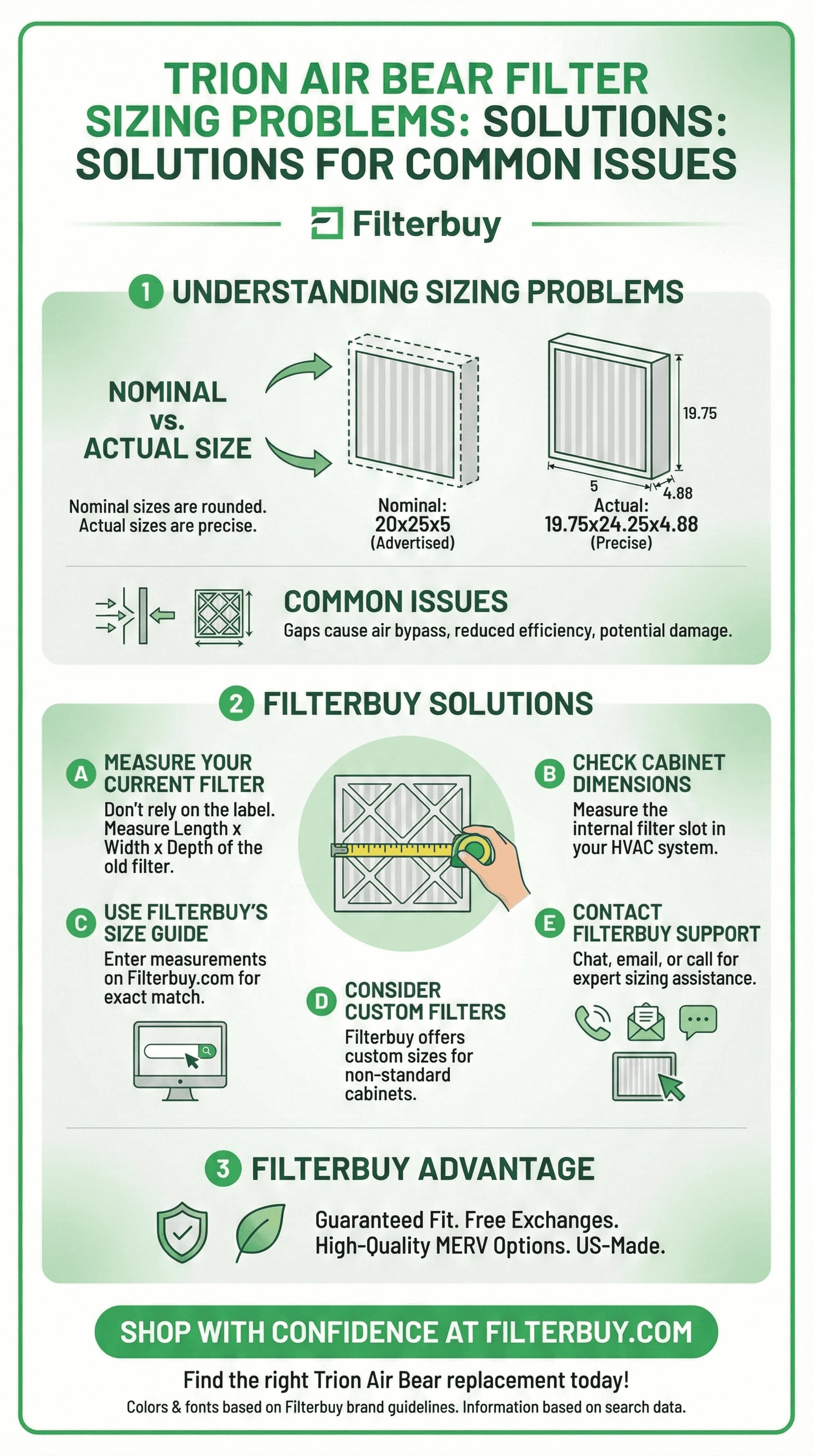
The most common source of Trion Air Bear sizing frustration comes from misunderstanding how filter dimensions work. Every air filter has two sets of measurements: nominal (rounded marketing dimensions) and actual (precise physical dimensions).
Nominal dimensions are the rounded numbers you'll see on packaging and in product listings—like 20x25x5 or 16x25x5. These make shopping easier but don't tell the whole story.
Actual dimensions are the precise measurements of the filter itself. For example, a "20x25x5" Air Bear filter actually measures approximately 19.75" x 24.25" x 4.94". This quarter-inch difference on each dimension is intentional—it allows the filter to slide into the cabinet housing without forcing it.
Here are the most common Trion Air Bear sizes with their actual dimensions:
• 20x25x5 (Most Common): Actual: 19.75" x 24.25" x 4.94"
• 16x25x5: Actual: 15.75" x 24.25" x 4.94"
• 20x20x5: Actual: 19.75" x 19.75" x 4.94"
• 16x25x3: Actual: 15.75" x 24.25" x 2.94"
Why Proper Fit Matters for Your HVAC System
A filter that doesn't fit correctly creates more problems than many homeowners realize. Here's what happens when sizing goes wrong:
Filter Bypass
Gaps around an undersized filter allow unfiltered air to flow directly past the media. This contaminated air carries dust, pollen, pet dander, and other particles straight to your evaporator coil and throughout your ductwork. Over time, this buildup reduces system efficiency and can trigger allergy symptoms for sensitive family members.
Restricted Airflow
An oversized filter that you've had to force into the cabinet may compress or buckle, restricting airflow. This forces your blower motor to work harder, increasing energy consumption and potentially shortening equipment life. HVAC professionals consistently cite improper filter fit as one of the top causes of preventable system strain.
Seal Failure
Trion Air Bear filters feature double gaskets designed to create an airtight seal against the cabinet housing. When dimensions don't match, these gaskets can't do their job effectively, allowing filter bypass even when the filter appears to fit.
How to Measure Your Air Bear Filter Correctly
Getting accurate measurements is straightforward when you follow the right process:
1.Remove your existing filter. Note that most Air Bear cabinets require approximately 26 inches of clearance to slide the filter out completely.
2.Look for printed dimensions. Check the filter frame for the nominal size—it's usually printed on the cardboard edge or the filter's label.
3.Measure the filter itself. Using a tape measure, record the length, width, and depth to the nearest quarter inch. Compare these actual measurements to the nominal size.
4.Measure your cabinet opening. If you can't find your old filter or its markings are worn, measure the interior dimensions of the filter cabinet. The filter you need should be approximately 1/4" to 1/2" smaller than the cabinet on each dimension.
5.Check your Air Bear model number. The model number on your Air Bear cabinet (such as 255649-105 or 259112-102) corresponds to specific filter dimensions and will help you find exact-fit replacements.
Pro Tip: Take a photo of any labels on your existing filter and the cabinet before removing the filter. This documentation helps if you need to reference specifications later or contact customer support.
Matching Filters to Your Air Bear Model
Trion manufactures several Air Bear cabinet models, each designed for specific filter sizes. Here's how to match your system:
Common Air Bear Cabinet Models
• Air Bear Supreme 2000: Uses 20x25x5 filters, features moisture-resistant beverage board frame
• Air Bear Cub: Compact models using 16x25x3 or 16x25x5 filters
• Air Bear Right Angle: Designed for installations where space is limited, using various 5-inch filter sizes
When purchasing replacement filters, you have two reliable options: OEM Trion filters or compatible aftermarket alternatives. Quality aftermarket filters from reputable manufacturers meet the same specifications at often lower prices. Look for filters that match both the dimensions and the MERV rating of your original—Trion Air Bear systems commonly use MERV 8, MERV 11, or MERV 13 filters.
Important: Air Bear filters can work in non-Trion HVAC systems if dimensions and MERV ratings match your system's requirements. Always verify compatibility with your system manual before installing.

"After manufacturing filters for over a decade and working with millions of customers, we've learned that sizing issues account for nearly 40% of air filter problems homeowners encounter. The good news is that once you understand the difference between nominal and actual dimensions, finding the right fit becomes straightforward. Measure twice, order once—your HVAC system will thank you."
Essential Resources
These authoritative resources provide additional guidance for air filtration and HVAC maintenance:
1.EPA Guide to Indoor Air Quality — Comprehensive federal guidelines for maintaining healthy indoor air, including filtration best practices
2.ASHRAE Residential Air Filtration Standards — Industry standards for residential HVAC filtration and MERV rating explanations
3.Energy Star HVAC Maintenance Tips — Government-backed efficiency recommendations including filter replacement schedules
4.Trion Air Bear Product Information — Official manufacturer specifications and model documentation
5.NADCA Air Duct Cleaning Standards — Professional association guidelines for maintaining clean HVAC systems
6.Department of Energy Heating & Cooling Guide — Federal resource for optimizing home heating and cooling efficiency
7.Filterbuy Air Filter Size Guide — Complete filter measurement and sizing resource with compatibility information
Supporting Statistics
Research from federal agencies underscores the importance of proper air filtration:
1.Indoor air can be 2 to 5 times more polluted than outdoor air—and occasionally more than 100 times worse—according to the EPA's comprehensive indoor air quality studies. (EPA Indoor Air Quality Introduction)
2.Americans spend approximately 90% of their time indoors, making indoor air quality a significant health factor for most people. (EPA Report on the Environment)
3.Indoor air pollution ranks among the top five environmental health risks identified by EPA science advisory boards, affecting respiratory health, allergies, and long-term wellness. (EPA Indoor Air Quality Overview)
Final Thoughts & Honest Assessment
Trion Air Bear filters have earned their reputation as reliable whole-house air filtration solutions. The 5-inch pleated media design provides excellent surface area for capturing particles while maintaining lower static pressure than standard 1-inch filters—which means better airflow and less strain on your system. Many homeowners report their evaporator coils staying remarkably clean even after years of use with properly maintained Air Bear systems.
That said, the sizing confusion is real and understandable. The industry-wide practice of using nominal dimensions creates a learning curve for first-time buyers. Once you understand this distinction and have your actual measurements documented, future replacements become simple.
Our recommendation:
• Stick with 5-inch media filters if your cabinet supports them—the improved airflow and longer replacement intervals (typically 6-12 months depending on MERV rating and household conditions) make them worthwhile
• Choose MERV 11 for most homes as it balances effective particle capture with minimal airflow restriction
• Consider MERV 13 if household members have allergies or respiratory sensitivities
• Document your exact model number and dimensions somewhere accessible—tape a note inside your utility closet or save it in your phone
FAQ on Trion Air Bear Air Filters
1. Why doesn't my new Air Bear filter fit even though it's the same size as the old one?
Different manufacturers have slight variations in actual dimensions even when nominal sizes match. Always measure your existing filter's actual dimensions (not just the printed size) and compare them to the replacement filter's specifications before purchasing.
2. Can I use a generic 20x25x5 filter in my Air Bear cabinet?
Yes, as long as the actual dimensions match. Quality aftermarket filters designed for Air Bear compatibility work just as effectively as OEM options. Verify the actual measurements are within 1/8" of your original filter and that the MERV rating meets your needs.
3. How often should I replace my Trion Air Bear filter?
Most Air Bear filters last 6-12 months depending on your MERV rating, household conditions (pets, allergies, smoking), and local air quality. MERV 8 filters typically last longer than MERV 13 filters. Check monthly and replace when visibly dirty or when airflow seems restricted.
4. What's the difference between Air Bear MERV 8, MERV 11, and MERV 13 filters?
MERV 8 captures basic household particles like dust, pollen, and lint. MERV 11 adds finer particle capture including pet dander, mold spores, and smog. MERV 13 provides the highest filtration, capturing bacteria and some virus carriers. Higher MERV ratings have slightly more airflow resistance and typically need more frequent replacement.
5. My Air Bear cabinet has gaps around the filter—is this normal?
Small gaps of 1/8" or less around the perimeter are normal and allow for easy filter insertion. Larger gaps indicate a sizing mismatch. The double gaskets on Air Bear filters should create a tight seal against the cabinet rails when properly sized. If you're seeing significant gaps, re-measure your cabinet and verify you have the correct filter dimensions.
Learn more about HVAC Care from one of our HVAC solutions branches…
Filterbuy HVAC Solutions - Weston FL
2573 Mayfair Lane Weston FL 33327
(754) 296-3528
https://maps.app.goo.gl/E3tjmKf5VSWYghGc7